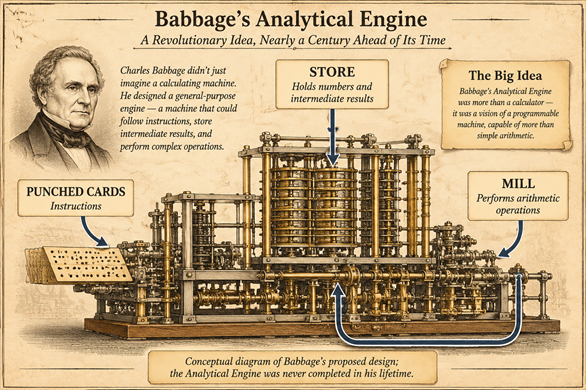
Faced with the unreliability of printed mathematical tables in the 19th century, Charles Babbage conceived the idea of making mathematical calculations simpler and more automatic. The Difference Engine of the 1820s was his first invention, followed by a more advanced one, the Analytical Engine. The former was an automatic mechanical calculator designed to use the finite-difference method for tabulating mathematical functions. The Analytical Engine, on the other hand, was an advanced version; it was more than a mere calculator. It marks the progression of babbage’s idea of mechanized arithmetic computation to an advanced general-purpose computation. The Analytical Engine was Babbage’s proposal, but it was more of a machine on paper. An idea that was never realized during his lifetime.
From calculating to computing
The Analytical Engine is like a conceptual loop from calculating to computing. While the two inventions were pioneering projects of Babbage, they differed in functionality. The Difference Engine was a purely mechanical calculator, designed to perform simple addition while avoiding complex multiplication and division. Its central purpose was to create reliable astronomical, navigational, and engineering tables.
On the other hand, the Analytical Engine was a programmable, general-purpose computer that could execute any arbitrary mathematical formulas and algorithms. It could perform the four basic arithmetic operations as well as logic and loops. The latter was more flexible compared to the former, which followed a fixed process.
The Store and the Mill
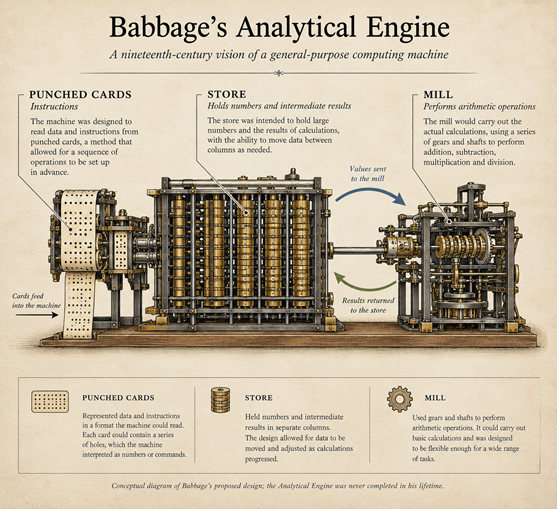
The Analytical Engine had two primary processing and memory parts that enabled its functionality: The Store and the Mill. The Mill served as the Central Processing Unit (CPU) as well as the Arithmetic Logic Unit (ALU). Babbage named it the “mill” because its physical gears and cogs “wound away” like mills to produce results. It had specialized features such as dual anticipating carry apparatus and dual anticipating carry apparatus that helped in executing basic arithmetic operations. These features retrieved numbers from the store, processed them in the mill, and sent them back to the store.
The store served as the machine’s memory. It had a capacity of 1000 numbers, each consisting of 50 decimal digits. Its design consisted of vertical axes and horizontal cage plates, with 40-digit figure wheels that could mechanically store numbers. The store was exclusively for storing data while the mill processed data.
Punched Cards and Instructions
Inspired by Joseph Marie Jacquard’s automated silk looms, Babbage figured that if punched cards could weave fabric patterns, they might also weave algebraic patterns. Therefore, he adopted Jacquard punched cards to work as the Analytical Engine’s input, control, and instruction system. The Analytical Engine required three separate card readers working together to feed the machine with instructions and data.
The Operation Card
The operation cards directed the mill. They contained specific arithmetic functions that needed performing, such as subtraction, addition, division, and multiplication.
The Variable Cards
Variable cards directed the store. Their role was to tell the machine where to find the numbers to compute and where to deposit the final results back into the store’s column.
The Number Cards
These were primarily used for inputting raw data. Initial values and constants into the machine’s store before calculation. Babbage’s system separated the “data location” from the “maths operation”. Since the machine could not read long lines of code, it received instructions as combined physical action between the Operation and the Variable Cards. The sequence of operations moved from fetching the operation to identifying variables, to moving the data, and finally to executing and storing. The fact that Babbage’s instruction system could make choices based on data, rather than being merely a linear checklist, made it revolutionary.
Repetition and conditional operations
The design contained a feedback loop between the Mill and the punched card readers that allowed it to achieve repeated operations and conditional branching. Gears, metal levers, and reversing mechanisms physically altered the path of the cardboard instruction cards. With conditional branching, the machine made decisions based on whether the computation results were negative or positive. The Sign Wheel, a specialized gear in the Mill, handled this operation. The machine also included Combinatorial Cards that enabled it to perform repeated operations. Babbage designed the card readers to use these Combinatorial Cards to move back and forth.
Why it was never completed
Despite babbage’s ambition and early progress, the Analytical Engine was never completed during his lifetime due to financial and technological struggles. There were several reasons that hindered his progress:
Inadequate Funding
After the failure to complete his first project, “The Difference Engine”, the British government lost confidence in Babbage’s work, hence cutting off funding for his projects. Securing private funding for such an enormous experimental machine was also a challenge.
Manufacturing Limits
The machine required many custom-made parts, including gears and levers that the 19th-century machining and metalworking technology could not produce. There was also limited engineering expertise, making it difficult to meet the machine’s engineering demand.
Babbage’s Perfectionism
Babbage was obsessed with perfectionism: instead of building a functioning machine with what was readily available, he kept changing his plans. He kept redesigning the machine to make it faster, larger, and more capable, which eventually delayed its completion.
What remained
What remained of Babbage’s Analytical Engine ambition was an extensive collection of Blueprints and a few “trial models”. Since the actual machine was never completed, it remains an engine on paper. It was a design that would usher in a new era of automated arithmetic computation, with minimal errors, that were common with the printed navigational tables of the 19th century.