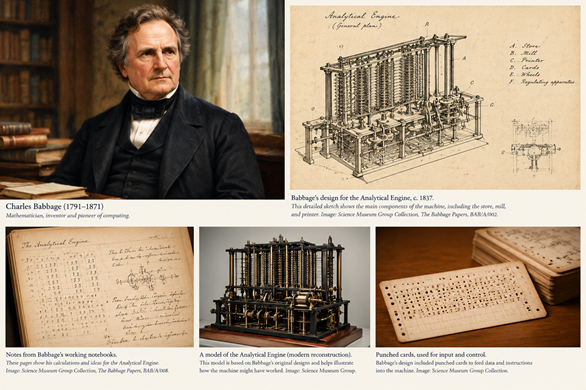
The mid-19th century was a period of unprecedented engineering ambition. Bankers, mathematicians, astronomers, engineers, and everyone needing mathematical calculations relied on printed numerical tables. Making these tables was tedious: manual calculation, copying, checking, and typesetting all required close attention. Besides, every stage of the production presented clerical errors that could pass from calculation to copying and printing and later affect decision-making. While studying the tables, Babbage and his friend, John Herschel, kept discovering error after error. This unreliability, combined with the tedious work of manually reading the tables, sparked Charles Babbage’s imagination of a mechanical calculating machine. Could calculation be made more systematic and less vulnerable to repeated human error? This question inspired his idea for a machine that minimizes human error through automatic typesetting and special security features to help ensure the integrity of the results. However, Babbage did not live to realize this dream.
Babbage encounters the problem and imagines a solution
Charles Babbage was an English mathematician and inventor born in London, Britain. He was active in the early 19th century and is credited with conceiving the first automatic digital computer. His deep concern about human error in astronomical and mathematical tables became the foundation of his idea. Errors in some tables posed threats to essential fields like engineering, astronomy, and finance.
Babbage identified that every stage introduced new mistakes, from initial calculation to manual transcription to typographical typesetting. He noted that these were not trivial mistakes; they cost the government billions of money. In 1821, Babbage’s collaboration with his friend and fellow mathematician, John Herschel, became the turning point for his career. The two became founding members of the Astronomical Society of London, with the aim of verifying a set of navigational and star tables. This project became the genesis of the computer age. An exchange between Babbage and his friend led him to conceptualize the Difference Engine, a possible mechanical solution for tabulating and computing mathematical functions using the finite-difference method.
The first machine and the larger ambition
The Difference Engine was Charles Babbage’s first machine designed in 1822. It was an automatic, steam-driven mechanical calculator for computing and printing error-free navigational and mathematical tables. He designed this machine to operate on the principle of finite differences, a mathematical technique that eradicates the need for complex division and multiplication. The idea was to reduce calculations to simple addition. Assembling the machine required approximately 25,000 separate parts, with the final product estimated to stand eight feet high and weigh about 4 tons.
The Difference Engine is an example of the earliest government-sponsored research and development projects. The British government invested a substantial amount of money in the project, which later led to a political scandal. However, Babbage had also set aside about 6000 to 13000 pounds to continue funding his dream in case the government pulled out. In 1842, the British government withdrew its funding for the project due to the lack of a tangible final product.
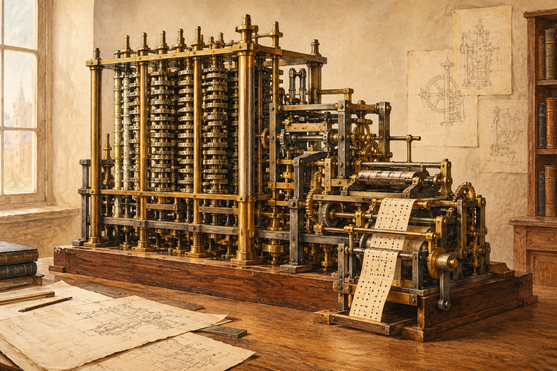
However, Babbage did not complete the Difference Engine project during his lifetime. He faced challenges such as construction limitations and disputes with his toolmaker, Joseph Clement. The Analytical Engine was Babbage’s greater ambition after the Difference Engine. The latter moved beyond simple arithmetic. It was a programmable general-purpose mechanical computer.
Ada Lovelace enters the story
Ada Lovelace was an English writer and mathematician. In 1833, at only 17, Ada displayed her interest and sharp mathematical mind, earning her and her mother an invitation to view Babbage’s working prototype of his project: the Difference Engine No. 1. While everyone else was merely interested in the outward appearance of Babbage’s work, Ada was more interested in its mechanical work and logic.
In 1840, she started studying advanced calculus to build the foundational skills needed to understand Babbage’s engineering concepts. In 1843, Babbage gave a presentation of the Analytical Engine, which Luigi Manabrea, an Italian engineer, later published. Ada went ahead and translated Luigi’s work into English. Later, Ada realized that the Analytical Engine was more than just a “calculator”. On top of translating Manabrea’s work, she added her own notes under the title “Notes by the Translator”. Her work focused more on the software than the hardware, exploring how the sequence of operations could be specified for the machine. Her published guide to calculating the Bernoulli numbers shows that she understood the art of manipulating abstract algebraic numbers.
What Lovelace saw—and what she did not claim
Ada’s core insight was the Analytical Engine as an all-purpose symbol manipulator rather than a mere calculator. While Babbage viewed it as a solution for automating complex mathematical tables, Lovelace viewed the machine’s fundamental logic and saw a completely different paradigm. Her reasoning was the transition from numbers to symbols. She also looked at the separation of data from processing, becoming the first to distinguish between variables and operations.
Even with all these improvements, Charles Babbage did not complete his invention in his lifetime. Financial difficulties, engineering limitations, and Babbage’s own obsession with perfectionism made it difficult to complete the Analytical Engine.
From a simple desire for reliable arithmetic calculations, Babbage’s ambition grew into a general-purpose computer capable of abstract logic. Babbage only wanted to make calculations easier and more reliable, which prompted him to invent the single-function calculator, the Difference Engine. However, this vision inspired other scientists to continue his work and scientific research to infinite versatility, working towards the Analytical Engine, a general-purpose computer.