Today, arsenic is a known toxin that can cause symptoms such as nausea, vomiting, headaches, and muscle cramps from acute exposure. With long-term exposure, it can lead to persistent tiredness, numbness and tingling in the hands and feet, certain types of cancer, and cardiovascular disease. Despite what’s known now, back in the day, arsenic was used for medicinal purposes and still is to this day — just in a much more controlled manner.
Over 2,000 Years Ago in Greece and Rome
In Greece and Rome, arsenic minerals were common in topical treatments to remove diseased or damaged tissue and treat ulcers.
You’ve probably heard of the Greek physician Hippocrates, commonly referred to as the Father of Medicine. He determined that diseases have natural causes rather than supernatural ones. Some historical accounts describe him as having used realgar (xionghuang) and orpiment — a mineral containing arsenic trisulfide — to remove damaged tissue and promote scabbing to ultimately heal ulcers, abscesses, and other skin conditions.
Dioscorides, a Greek physician and pharmacologist, reportedly used arsenic-containing minerals like orpiment to stop skin growths, remove hair, and treat ulcers. He documented those external uses in his medical encyclopedia, De Materia Medica. In it, he also acknowledged arsenic was harmful when swallowed and could cause gastrointestinal distress.
Although less common, the Greeks and Romans used arsenic internally to treat respiratory ailments. Specifically, Dioscorides reported using arsenic to treat asthma in his medical encyclopedia, while other ancient physicians were using it for voice problems and coughs.
Over 2,000 Years Ago in China
Arsenic’s use in traditional Chinese medicine dates back more than 2,000 years. Arsenic trioxide, also known as white arsenic, was among the compounds used, specifically to treat infections and skin conditions. Interestingly enough, even then, practitioners recognized there was a fine line between a safe dosage and a potentially dangerous one.
Realgar is a mineral primarily consisting of arsenic that practitioners used to treat skin conditions, infections, and parasites.
Less commonly, arsenic was given orally for fevers, epilepsy, and malaria. People took realgar and arsenolite (arsenic trioxide) orally to promote longevity.
In the Middle Ages
During the Middle Ages, around 500 to 1500 AD, arsenic was still being used topically to treat ulcers, sores, and other abnormal skin growths. This time period was a turning point for medicinal arsenic because physicians and pharmacists started using arsenic-containing minerals internally more frequently.
Persian physician Avicenna was using arsenic at the time to treat fevers. In the 11th century, Andalusian surgeon Al-Zahrawi included an arsenic preparation method in his medical encyclopedia. Throughout this time period, physicians were also using arsenic in an attempt to treat tumors and cancer topically and internally.
In the eastern Mediterranean area, physicians were also working on treatments for sexual ailments, eye issues, skin conditions, and hemorrhoids, and some therapeutic approaches included arsenic.
In the 1600s and 1700s
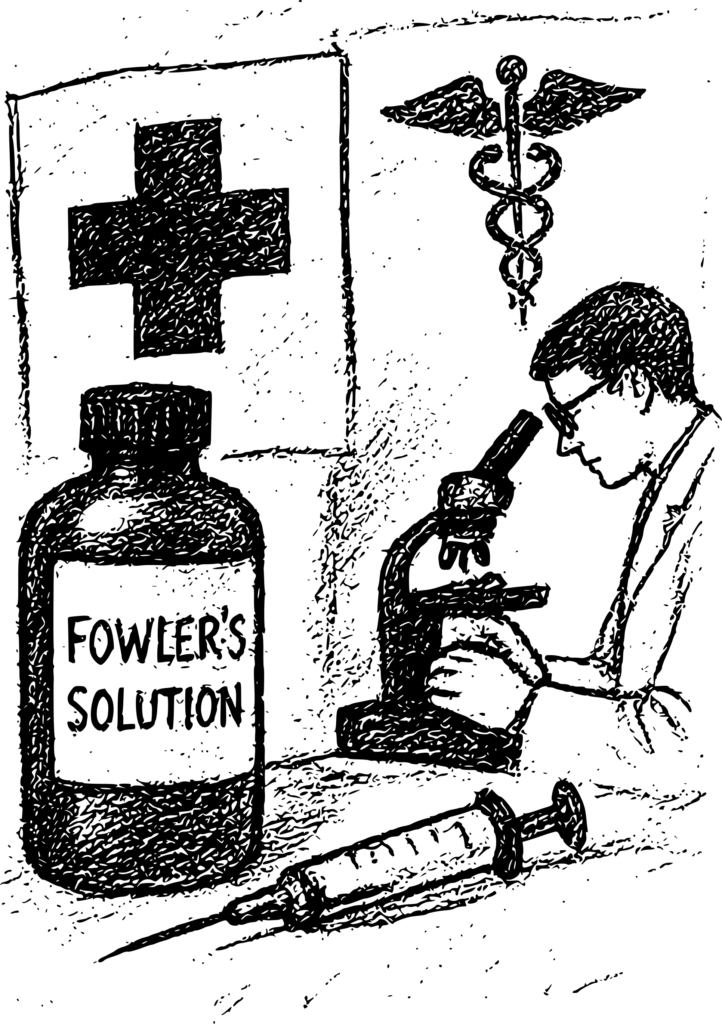
After the Middle Ages, arsenic use became widespread and was used for multiple applications. In some cases, arsenic-containing preparations were administered by injection. British physician Thomas Fowler developed Fowler’s solution, a potassium arsenite preparation used for asthma, skin conditions, fevers, headaches, and epilepsy.
In the 1800s
Physicians were still prescribing Fowler’s solution in the 1800s as well as other arsenic-based medications, but the list of indications grew to include:
- Syphilis
- Hodgkin’s disease
- Tuberculosis
- Leukemia and other blood disorders
- Rheumatism
While arsenic was initially only for acute illnesses, some doctors began using it for long-term maintenance of chronic conditions during this time.
In the 1900s
The early 20th century marked decades of arsenic use for treating syphilis — a common infection during the late 1800s and early 1900s. To give a general idea of how prevalent it was, historical estimates indicate five to 20 percent of people in the US and Europe had or would have syphilis.
In the early 1900s, up until penicillin was proven as an effective treatment for syphilis in the 1940s, arsenic, though sometimes mercury, was the standard treatment for syphilis.
Around the 1950s
By the 1950s, medicinal arsenic use began to decline as a result of people becoming aware of the toxicity and potential carcinogenic effects of this treatment. The use of antibiotics and other treatments also played a role in its decreased use.
The 1970s to Today
Chinese researchers investigated the use of arsenic trioxide for the treatment of cancer once again in the 1970s. After establishing its potential to treat the rare blood cancer acute promyelocytic leukemia (APL), other researchers began confirming its effectiveness against this cancer and others.
One study conducted in China showed that nine of the 10 individuals with relapsed APL achieved complete remission after using arsenic trioxide, representing a 90-percent full remission rate. Other studies also showed it was effective in treating patients with APL who didn’t respond to the typical treatment protocol.
In 2000, the U.S. Food and Drug Administration (FDA) reviewed a clinical study conducted on 40 patients with relapsing or treatment-resistant APL. It showed promising results, with 28 of 40 entering remission.
On September 25, 2000, the FDA approved arsenic trioxide (Trisenox) for treating patients who have APL that relapsed or wasn’t responsive to other treatments. In 2018, it was approved for use with tretinoin to treat newly diagnosed, low-risk APL.
Research has been conducted on its use for other cancers, including multiple myeloma, acute myeloid leukemia (AML), and lymphomas. It’s also been investigated as a potential treatment for myelodysplastic syndromes (MDS). However, as of 2026, Trisenox hasn’t been approved for any other conditions.
Today, people are aware of the potential dangers of arsenic, so it’s not widely used for medicinal purposes in the US. However, for more than two thousand years, physicians in various countries recommended it for treating everything from skin disorders to respiratory issues. Nowadays, it’s available as an FDA-approved cancer treatment, but better knowledge of the pharmaceutical formulation, established dosage recommendations, and side-effect management have made it a more standardized and heavily regulated arsenic-based option than treatments of the past.